




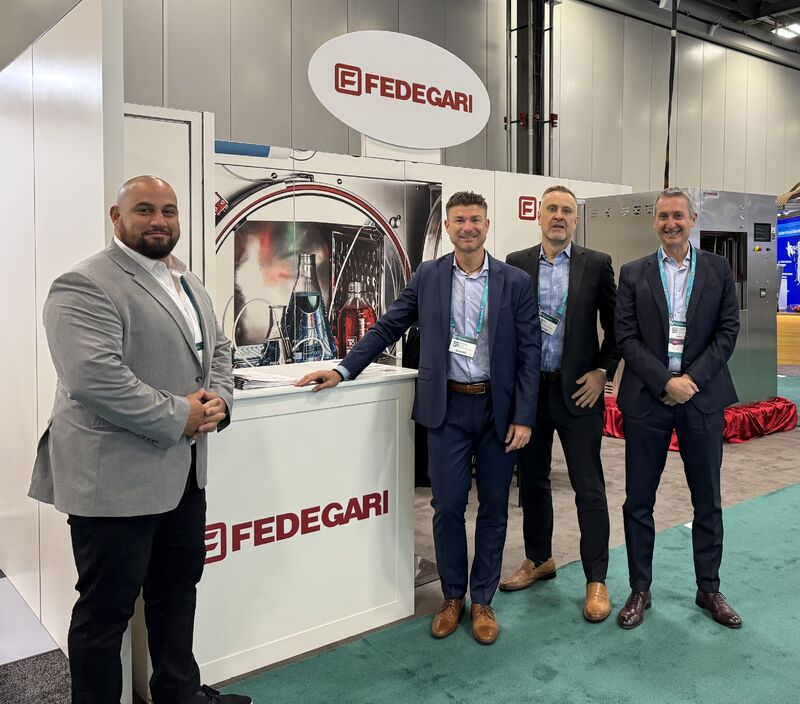
We sat down with Dan Cancelliere, Commercial Director for the Americas at Fedegari, to talk about what “being close to the customer” really means, why customization is critical in sterile manufacturing, and what excites him most about where the industry — and Fedegari — are heading.
In your role as Commercial Director for the Americas, what does “being close to the customer” mean at Fedegari beyond physical proximity?
Being close to our customer means truly understanding their processes and challenges at a deep level. At Fedegari, that proximity allows us to bring real expertise to the table, expertise that helps customers bring life-saving products to market with maximum efficiency and uncompromising safety.
It’s not about simply delivering equipment. It’s about understanding how sterilization, washing, and decontamination fit into a much larger production and quality ecosystem.
What are the most common challenges you’re seeing American pharma manufacturers face today in sterilization, washing, or decontamination? How are those needs evolving?
One of the biggest challenges we see is a continued reliance on legacy solutions due to a lack of technical insight into newer alternatives. Too often, processes are treated as “standard” when in reality, small differences in product design or production requirements can have major implications for performance and validation.
At Fedegari, we challenge the status quo by applying experience built over decades and pairing it with continuous improvement. While applications may look similar on the surface, each one has unique requirements that must be tested, not assumed.
We’re also seeing customers become more open to exploring new technologies. Education around these advancements had declined for a period, but it’s now experiencing a resurgence as their impact on productivity, safety, and reliability becomes clearer.
Fedegari often works outside of off-the-shelf solutions. Why is customization and early collaboration so critical in sterile manufacturing projects?
Sterilization is never one-size-fits-all. Even when applications appear similar, meaningful differences exist that can directly affect outcomes.
As life-saving products and production technologies evolve, sterilization processes must be validated through testing, rather than being assumed. Early collaboration allows us to understand those nuances upfront and design solutions that are truly aligned with each customer’s product, facility, and long-term goals.
Customization isn’t complexity for its own sake. It’s how we ensure performance, compliance, and reliability over the life of the system.
Why does seeing the technology up close still matter in an increasingly digital world, and how does that hands-on engagement help customers make more confident decisions?
There’s real value in being able to see, touch, and evaluate technology in person. Understanding how a system operates, and why it was designed the way it was, creates a meaningful differentiator, especially for complex, mission-critical equipment.
Those in-person experiences also build trust. They provide tangible proof of quality, performance, and the expertise behind the solutions we propose. Being physically present with our customers reinforces partnership and confidence. At Fedegari, we don’t deliver a solution and disengage; we stay involved throughout the process to support long-term success.
Industrial sterilization is not a commodity. It’s a vital element of medical product development and ongoing production. Hands-on engagement allows customers to fully understand that value and make informed decisions with confidence.
How do you see the role of the commercial team changing as customers prioritize efficiency, reliability, and long-term performance?
Our role continues to shift toward a more consultative mindset.
As customers place greater emphasis on reliability and lifecycle performance, the ability to deliver deep process knowledge through our frontline commercial team becomes even more critical. Continuous improvement and long-term collaboration are central to how we support our customers.
From your perspective, what truly differentiates Fedegari as a partner, not just an equipment supplier?
Fedegari is not simply an equipment supplier. We are global leaders in sterilization expertise.
We advance the industry by creating new experiences, pushing boundaries, and exploring solutions others may not be willing to pursue. That level of innovation is only possible through true partnerships with forward-thinking, inquisitive leaders who challenge conventional approaches.
Our goal is to revolutionize sterilization solutions and openly share our learnings to help accelerate the advancement of life-saving products worldwide.
What excites you most about where Fedegari is headed in the Americas over the next year and what trends do you see shaping the next five?
What excites me most is the opportunity to share new experiences with both existing and new partners across the Americas.
Our approach is fundamentally different. We don’t offer off-the-shelf solutions. We deliver highly customized systems designed around evolving product and production-specific requirements. While the Fedegari brand is still newer in the Americas, our foundation is built on more than 80 years of sterilization expertise.
Sharing who we are, how we think, and why we do what we do with customers across the region is a powerful opportunity. Looking ahead, I believe increased customization, deeper collaboration, and a renewed focus on process knowledge will continue to shape the future of sterile manufacturing.